Meta-Analysis Shows AI Screening Triples Diabetic Eye Referral Completion in US Clinics

In diabetic retinopathy screening, detecting disease is only the beginning. Delivering an immediate diagnosis and ensuring patients complete their specialist referral are equally critical to closing the care loop.
A systematic review and meta-analysis published in npj Digital Medicine (Leigh et al., 2026) evaluating the impact of AI-assisted DR screenings compared to standard of care, found that AI screening pathways substantially reduce referral drop-off. Globally, AI-enabled pathways raised referral completion by 23.9%s.
In US primary care settings, where baseline referral completion was the lowest in the review (between 12% to 22%), AI-assisted screening delivered its most dramatic impact: referral completion nearly tripled in each of the three US studies.
Drivers of US Primary Care Performance Gains
Across the three US-based studies evaluated in the meta-analysis, shifting from traditional pathways to AI-assisted screenings delivered massive relative gains:
US Study & Setting | Standard Care Completion | AI Pathway Completion | Point Gain |
Wolf et al. (2024) Pediatric diabetes center, RCT | 22.0% (18/82) | 64.0% (16/25) | +42.0 pts |
Liu et al. (2021) Adult primary care, prospective, n=1,066 | 18.7% | 55.4% | +36.7 pts |
Dow et al. (2023) Primary care network, retrospective | 12.0% (14/117) | 35.5% (99/279) | +23.5 pts |
American clinics started with the lowest baseline follow-up rates compared to international peers (which ranged from 39.6% to 77.3%). While one study evaluated a pediatric diabetes center (Wolf et al., 2024), an environment with distinct operational and caregiver workflows, the broader trend remains clear: US healthcare systems had the most room to grow and achieved the largest relative leaps when adopting autonomous AI pathways.
The Secret: Same-Visit Diagnostics
Why does autonomous AI succeed where traditional teleretinal screening stalls? It eliminates the diagnostic lag.
Speed is only half the equation; referral precision is the catalyst. Rather than issuing blanket referrals for all diabetic patients, the screen-first model isolates only the ~12% of patients who were identified as positive for diabetic retinopathy. Instead of flooding specialists with routine screens, clinics send patients who have an immediate, clinical reason to go. In fact, Dow et al. delayed results by 48 hours and still saw completion triple, proving that while point-of-care speed delivers convenience, focusing on patients who screen positive drives the outcome.
Standard pathways refer every diabetic patient to a specialist and hope for the best. Point-of-care AI redesigns the care pathway:
Immediate Answers: Patients receive a definitive diagnostic result while still in the exam room.
Instant Action: Primary care staff discuss the results on the spot with patients, and refer them for specialist follow-up before the patient walks out the door.
No Friction: Modern autonomous AI can be operated by clinic staff at the point of care, without requiring specialist overreads.
This pathway shift directly improves quality metrics that drive value-based care, including HEDIS Eye Exam for Patients With Diabetes, MIPS Measure 117 (CPT 92229), and Medicare Advantage Star Ratings.
The studies in the meta-analysis proved that bringing AI into the clinic nearly triples follow-up rates. However, those early studies relied on legacy tabletop hardware, multi-image capture protocols, and standalone software workflows.
Exceeding the Baseline: The AEYE-DS Advantage
While the meta-analysis proves the clinical rationale for point-of-care AI pathways, those early studies relied on tabletop hardware, multi-image capture protocols, and standalone software workflows.
To achieve gains beyond baseline trial numbers, healthcare organizations require a solution engineered specifically for primary care constraints. As the fastest-growing autonomous AI screening solution in the US, AEYE-DS represents the premier point-of-care screening solution:
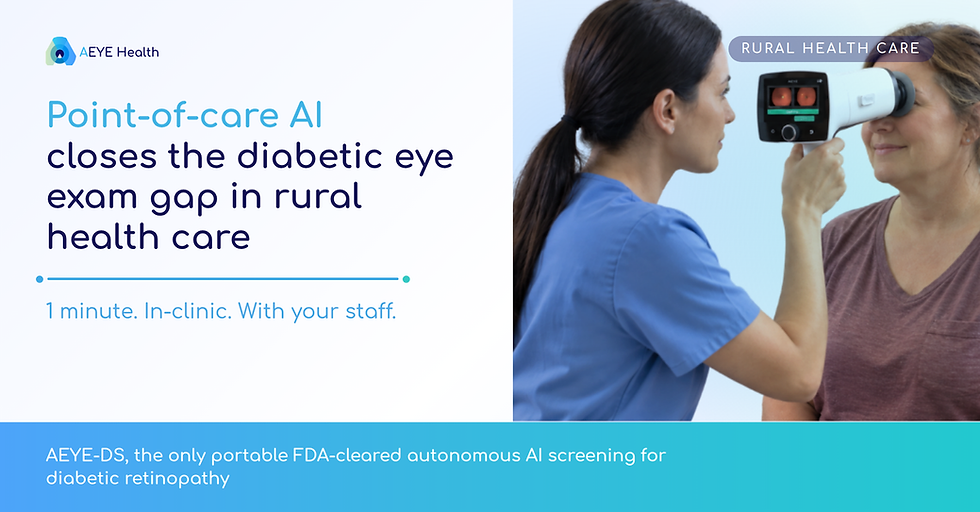
One image per-eye: AEYE-DS is the only FDA-cleared autonomous AI that requires just one image per eye, without dilation.
The only portable solution: It is the only autonomous AI cleared for use with portable, handheld fundus cameras. The solution is also cleared with a robotic tabletop camera providing clinics with the freedom to choose the best solution for their rooms and patient volume.
1-minute exam with instant results: The entire screening takes under 1 minute to complete, proving instant results while patients are still in the clinic.
Seamless EHR Workflow Integration: Syncs seamlessly into major EHR platforms (including Epic) to trigger immediate screenings from care alerts, automate documentation and billing, and streamline specialist referrals, all without adding staff burden.
Real-world health systems demonstrate what happens when these specific operational advantages are applied in practice. When UMass Memorial Health deployed AEYE-DS directly inside their EHR workflow, diabetic eye screening adherence climbed from 29% to 49% in just four months, while average screening exam times dropped by 75%.
When the screening seamlessly fits into clinic workflows during the primary care visit, they become a standard of care, improving patient outcomes and clinic performance.
Resources
Leigh JA, Sherrington A, Barber ARJ, Turner AW, Kidd M, Powell J, Pope C. Referral uptake after diabetic retinopathy screening with artificial intelligence-assisted care pathways: a systematic review and meta-analysis. npj Digital Medicine. 2026. doi:10.1038/s41746-026-02616-3 https://www.nature.com/articles/s41746-026-02616-3
US Food and Drug Administration. 510(k) premarket notification K240058, AEYE-DS. Decision date 23 April 2024.