Early Diagnosis Is the Vision: Bring the Diabetic Eye Exam Into the Routine Visit
A patient with diabetes can sit across from their primary care physicians or endocrinologists every few months for years, reviewing labs, adjusting insulin, tracking A1c, and still never have their eyes checked in that very same room.
The diabetic eye exam is a known quality measure and one of the toughest care gaps to close. Diabetic retinopathy is the leading cause of preventable blindness in working-age adults, and early detection can prevent more than 95% of that vision loss. Because the exam usually depends on an external referral and a separate appointment with an eye specialist, more than 60% of people with diabetes miss it. In its early stages, diabetic retinopathy often has no noticeable symptoms, leaving patients who feel fine with little urgency to schedule another appointment.
This World Diabetes Day, on November 14, the call is for early action: early diagnosis, risk reduction, and timely access to care. For people managing diabetes, early action starts with screening for diabetic retinopathy before vision is affected, and with AI diabetic eye exams, those screenings can happen during routine visits patients already attend.
Screen where diabetes is managed
For care teams and health systems, closing this gap requires point-of-care diabetic retinopathy screening that is accurate, fits seamlessly into existing workflow, and provides an immediate clinical next step.
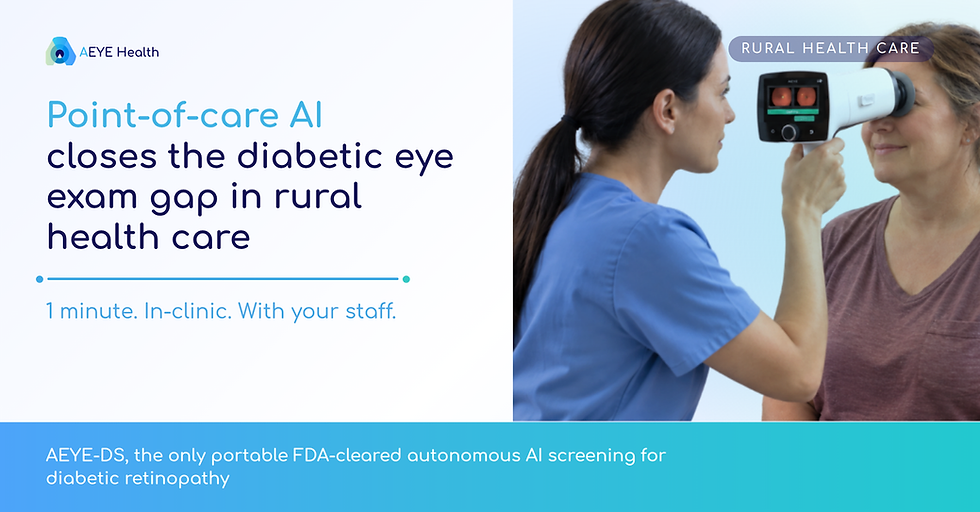
AEYE-DS is FDA-cleared autonomous AI that detects more-than-mild diabetic retinopathy (mtmDR) during routine visits. Clinic staff capture a single image per eye during rooming, and the result is ready before the patient leaves. It is the only FDA-cleared autonomous AI screening solution cleared on a portable handheld camera, and the only AI that requires just one image per eye for the analysis. AEYE can as well be used with a robotic tabletop camera, ensuring patients can be screened at any point of care and adjust to the clinic’s setting. AEYE-DS offers a simple workflow for both patients and staff. In November 2026, AEYE-DS received the Prix Galien USA Award for Best Digital Health Solution.
As the fastest-growing autonomous AI eye screening solution in the US, here is why care teams are adopting it:
1-minute exam, with instant results at the point of care
The only FDA-cleared autonomous AI on a portable camera, also cleared on a robotic tabletop camera. Clinicians can choose and mix types of hardware devices.
The only solution that requires just 1 image per eye
No dilation and no specialist interpretation required. Results are final by the AI.
>99% imageability in three prospective studies of more than 1,200 patients
Best in class diagnostic efficacy: Sensitivity of 93% (tabletop) & 92%–93% (handheld), specificity of 91.4% (tabletop) & 89%-94% (handheld)
Seamlessly integrated with all major EHRs including Epic
A clear next step for every result
Because the diagnostic result is generated instantly during the visit, the endocrinologist or primary care provider can discuss it with the patient on the spot. Insufficient quality images can also be retaken while the patient is still there. Patients diagnosed with referable mtmDR are referred to an eye care specialist for treatment; while patients with negative results will be simply screened again the following year at their next visit or routine check-up.
Results are seamlessly documented in the EHR, supporting HEDIS EED and MIPS 117 quality measure performance. The exam is reimbursable under CPT 92229 featuring significantly higher reimbursement than traditional tele-retina codes.
This World Diabetes Day, early action on diabetic retinopathy can begin before the patient leaves the endocrinology clinic. With timely follow-up, that one-minute exam can help save their sight.
See how AEYE-DS fits your clinic's workflow. Book a demo.