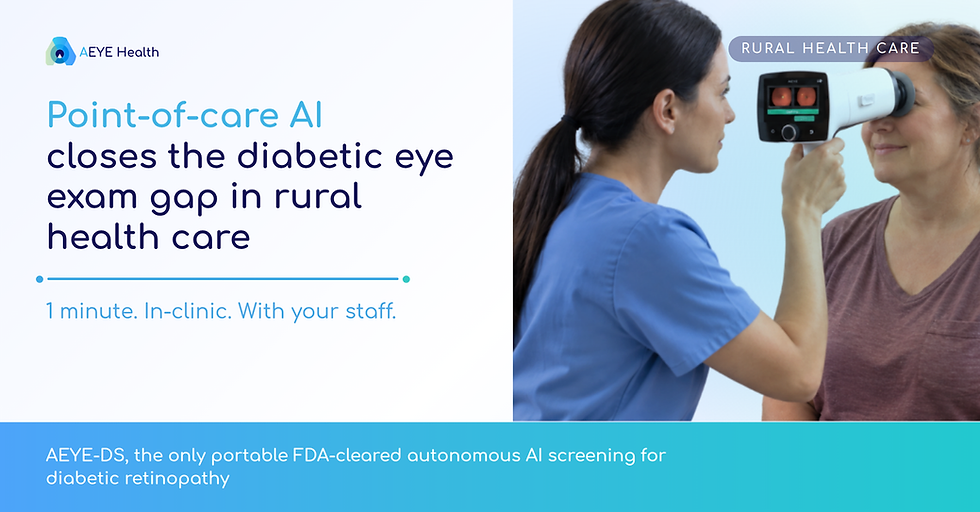
The Complete Diabetes Visit: Screening for Diabetic Retinopathy in Primary Care With Autonomous AI

Managing diabetes across large patient panels presents a persistent operational hurdle: closing the annual diabetic eye exam gap.
Nationally, over 60% of patients with diabetes fail to complete their yearly eye screening (AAO, 2024). The traditional care model, issuing an external referral to an off-site optometrist or ophthalmologist, suffers from severe attrition.
Long specialist wait times, transportation barriers, and missing consultation reports leave quality metrics unfulfilled and patients at risk of preventable vision loss.
At AAFP FMX 2026, the solution is on display: point-of-care autonomous AI screening that closes the gap before the patient leaves the clinic. By embedding point-of-care autonomous AI screening directly into routine primary care visits, clinical leaders are delivering a comprehensive, single-visit experience that closes care gaps before the patient leaves the clinic.
The Operational Cost of External Referrals
Relying on off-site specialist referrals for baseline screening creates several systemic challenges for health systems:
Care Gap Leakage: Over 60% of patients with diabetes do not complete their annual eye exam.
EHR Data Fragmentation: Specialist reports often don't flow back into primary care EHRs automatically, so staff chase documentation for quality audits.
Lost value-based revenue: Open eye exam gaps lower performance on HEDIS (EED), MIPS Measure 117, and CMS Star Ratings, leaving shared savings uncaptured.
Formally Backed by Clinical Guidelines: The 2026 ADA Standards of Care
Point-of-care autonomous AI is no longer an experimental pilot; it is an established clinical standard of care. In the 2026 American Diabetes Association (ADA) Standards of Care, Recommendation 12.6 explicitly names AEYE-DS among FDA-cleared autonomous AI platforms as a validated, evidence-based screening strategy for diabetic retinopathy (Diabetes Care, 2026). This formal endorsement provides the regulatory, clinical, and risk-management backing needed to confidently transition to enterprise-wide rollout across primary care networks.
What a same-visit diabetic eye exam looks like: A 1-Minute Workflow
Integrating autonomous diagnostic AI screening with AEYE-DS into routine diabetes visits transforms screening into a brief, non-invasive protocol managed by clinic staff:
Flag the patient: your EHR flags patients due for their eye exam.
Image capture: your staff (MA, LPN, RN) capture just 1 image per eye without dilation. It's the only solution that needs just one, so screening stays simple and swift.
Instant results: FDA-cleared autonomous AI delivers instant results and report, allowing providers and patients to discuss them in the visit and refer patients only when needed.
Seamless EHR integration: the results are automatically recorded in the patient’s file, the billing is triggered, and reporting is streamlined.
In three pivotal studies behind AEYE Health’s FDA-clearances, AEYE-DS achieved 99% imageability and 92% to 93% sensitivity (Dvey-Aharon et al., Frontiers in Digital Health, 2026).
AEYE-DS is also the only FDA-cleared autonomous AI on a portable camera, so staff can move it between exam rooms. It's also cleared on a robotic tabletop camera, so you choose the setup that fits. No specialist read is needed.
Executive Impact: Quality, Economics, and Efficiency
For healthcare leaders evaluating point-of-care AI adoption, the operational and financial benefits align directly with enterprise goals:
Strategic Priority | Point-of-Care AI Impact |
HEDIS & Star Ratings | Replaces referral leakage with instant exams, lifting CMS Star Ratings and ACO quality metrics. |
Reimbursement (CPT 92229) | Enables billing under CPT 92229 with a $45-50 national medicare average (often higher with private payers). Because the AI is fully autonomous, practices retain 100% of the reimbursement without paying for specialist over-reads. |
EHR Interoperability | Diagnostic outputs populate directly into major EHR platforms (such as Epic, and Cerner), eliminating manual document retrieval. |
Transforming Diabetes Care at FMX 2026
By upgrading standard diabetes checkups to include AEYE-DS, point-of-care autonomous AI screening, health systems can protect patient sight, maximize quality incentives, and deliver true comprehensive care under one roof.
Attending FMX? Come see it live, book a meeting and visit us at booth 1006.
Not at FMX? book a personalised demo to see how point-of-care AI can transform your primary care network.
References
Boyd K. "Six Out of 10 People with Diabetes Skip a Sight-Saving Exam." American Academy of Ophthalmology, EyeSmart, September 23, 2024.
American Diabetes Association Professional Practice Committee. "12. Retinopathy, Neuropathy, and Foot Care: Standards of Care in Diabetes 2026." Diabetes Care, vol. 49, suppl. 1, 2026, p. S261.
Dvey-Aharon Z, et al. "Autonomous AI-driven point-of-care screening for diabetic retinopathy compared to reading center multi-expert clinical review: results from three prospective controlled pivotal validation studies with AEYE-DS in over 1,200 patients." Frontiers in Digital Health, vol. 8, 2026, art. 1907804. Open access.
Centers for Medicare & Medicaid Services. "2026 Star Ratings Measures." CMS, 2026.