Defining the Standard: AEYE-DS Recognized in the ADA 2026 Standard of Care

The publication of the American Diabetes Association’s (ADA) 2026 Standards of Care in Diabetes represents more than a clinical update; it is a structural transformation in the delivery of diabetic eye care. For years, the "referral-based" model for diabetic retinopathy (DR) has faced a systemic bottleneck, leaving the vast majority of patients without their essential annual screening.
By formally integrating autonomous AI into the 2026 guidelines, the ADA has signaled that the future of vision preservation lies in the primary care setting. At the forefront of this transition is AEYE-DS, a technology now recognized within the highest tier of clinical standards.
The Strategic Shift: From Referrals to Point-of-Care
The 2026 Standards recognize a critical supply constraint: the widening gap between a growing diabetic population and the finite availability of retina specialists. This structural mismatch is particularly urgent given that diabetic retinopathy remains a leading - but largely preventable - cause of vision loss in the U.S. Despite the availability of effective treatments, the care pathway is often obstructed by prohibitive delays in specialist access.
The ADA's endorsement of FDA-cleared autonomous AI (Section 12.6) is a strategic move to decentralize diagnostics. By embedding AI screening into the routine primary care workflow, the ADA is transitioning the industry from a reactive referral model to a proactive diagnostic model. This ensures that DR is identified at the point of care, where the patient is already being managed, effectively closing the care gap.
A New Clinical Reality
The ADA 2026 Standards of Care now integrate autonomous AI screening into the standard workflow for diabetic retinopathy detection, to deliver guideline-based care at scale. This positions AI not as an adjunct innovation, but as a practical mechanism to address the persistent shortage of eye care specialists.
As the global burden of diabetes continues to rise, demand for retinal screening has outpaced the specialist availability creating a bottleneck that contributes to preventable vision loss. In response, the ADA highlights the role of validated, autonomous AI tools for diabetic retinopathy screening as a means of expanding access and improving efficiency. These technologies are recognized as capable of performing screening at the point of care, reducing dependence on specialist interpretation for initial detection, and helping ensure that more patients are screened within recommended intervals.
AEYE-DS: A Validated Standard
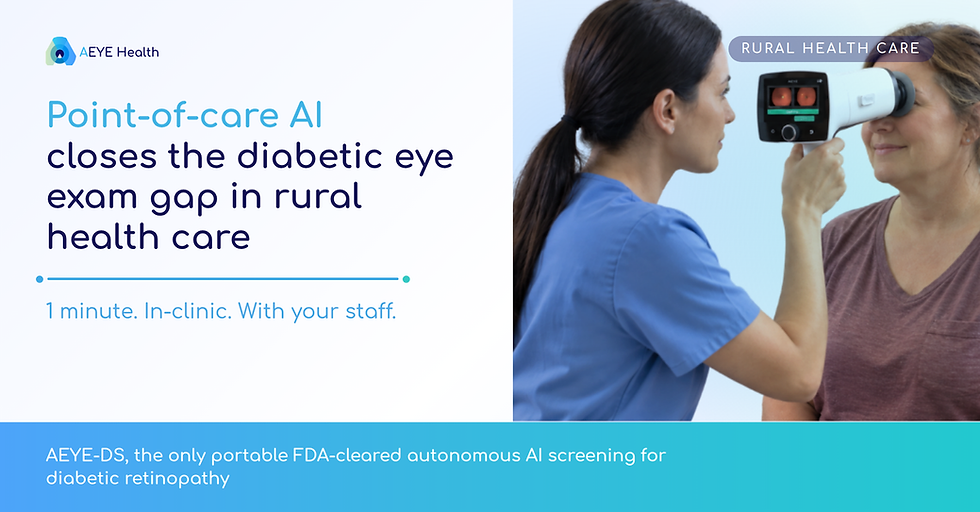
The ADA Standards of Care specifically mention AEYE-DS first, recognized as a validated FDA-cleared diagnostic diabetic retinopathy screening solution. AEYE-DS delivers immediate, point-of-care results without the need for specialist interpretation, enabling a start-to-finish 1-minute eye exam using just one image per eye. This allows providers to close care gaps during the same clinical visit with 100% compliance and >99% imageability (“success rate”) before the patient leaves the clinic. Seamless EHR integration streamlines workflows through fully-automated recording, billing, and referral triggers, keeping both patients and revenue in-house while supporting HEDIS and MIPS 117 requirements.
Why this matters in practice:
Portability & Usability: AEYE-DS is the only FDA cleared AI solution for portable cameras, and also the only AI that requires just 1-image-per-eye, without dilation. By this, AEYE-DS fulfills the ADA's goal of bringing high-quality screening where specialists are not readily available.
Operational Efficiency: The ADA highlights that AI "enhances efficiency and reduces costs," allowing specialists to focus on treatments while AI manages routine diagnostics.
Verified Reimbursement: The Standards explicitly note that AI screenings are covered by most insurance plans, supporting the financial viability of CPT 92229.
By adopting AEYE-DS, providers move beyond the “referral black hole” to implement a clinical standard recognized by the world’s leading authority on diabetes. With the ADA 2026 Standards of Care accelerating this shift, AI-driven, autonomous screening is increasingly replacing traditional, referral-based methods - enabling faster, more accessible, and more consistent detection at the point of care.