Same image, different future: How AI screening outpaces Teleretina on speed, cost, and scale

Telemedicine sounded like a great promise for diabetic retinopathy (DR) screening. Take a few retinal images in a primary care clinic, upload them to the cloud, and let remote specialists read them. Clean, simple, and modern.
Except it isn't.
While teleretina solutions promised to close the care gap, health systems across the country are quietly abandoning these workflows.
The reason?
What works on paper collapses in a real clinic. Legacy teleretina creates massive administrative bottlenecks, delivers negative ROI, and fails far too often.
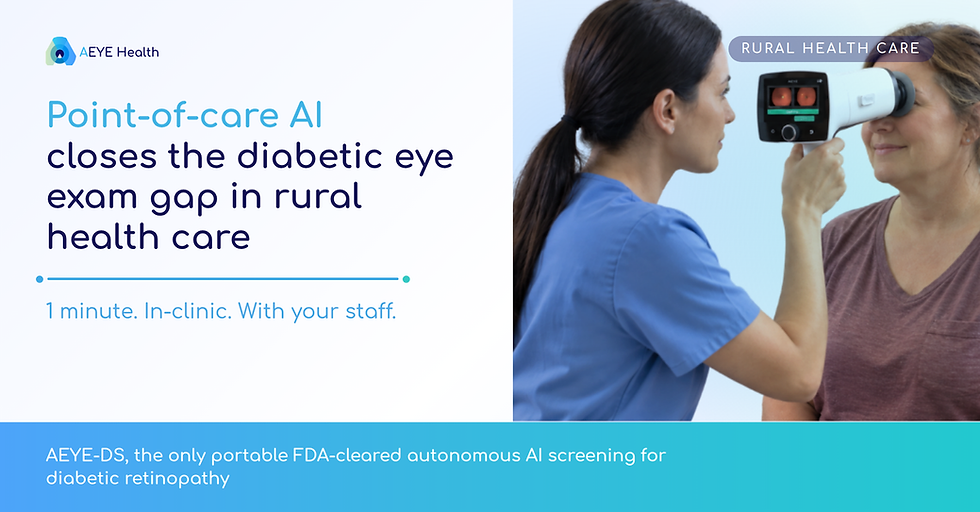
Route that same retinal image through autonomous AI, and everything changes. You replace a broken, frustrating process with a high-yield, 1-minute workflow that closes the care gap right then, in-visit.
Here is how AI is outpacing teleretina across the three metrics that matter most: speed, cost, and scale.
The 30% failure rate nobody talks about
The biggest headache with legacy teleretina? It suffers from a 30% ungradeable rate.
If the patient blinks, moves, or has small pupils, the screening fails. Nearly one in three screenings comes back days later marked "ungradable." So, staff have to track down the patient, call them back, or attempt a specialist referral. It’s exhausting.
The result?
Staff stops screening, and the camera collects dust.
AEYE-DS, FDA-cleared autonomous AI, eliminates this failure loop entirely.
The AI analyzes the photo instantly at the point of care. If a patient blinks, or the image is of insufficient quality for whatever reason, you simply retake it on the spot. Because it requires only one image per eye, FDA clinical data shows a >99% success rate (imageability). Virtually every patient screened gets an instant diagnosis.
Speed: Instant vs. days
In a traditional teleretina model, the image is uploaded to a cloud queue, where a remote specialist reviews it asynchronously. The turnaround time for a report typically ranges from 24 hours to several days. By the time the results are back, the patient is long gone, requiring clinic staff to chase them down for follow-ups.
This delay triggers a massive follow-up failure: a landmark study revealed that only 58.8% of patients with severe disease made it to an in-person eye exam, and a mere 23.7% were actually seen by a retina physician despite an explicit telescreening recommendation to “see a retina specialist ASAP.”
This gap exists because without immediate, in-office results, communication completely stalls; in fact, the study found that 80% of interviewed patients were entirely unaware they even needed a follow-up appointment. Without immediate urgency at the point of care, critical recommendations are lost and the care loop stays broken.
Autonomous AI eliminates the queue entirely. The entire screening, from image capture to diagnostic output, is completed in under a minute, while the patient is still in the room.
The clinical impact: immediate counseling and seamless, and same-day scheduling for patients requiring specialist care, closing the care gap for all patients instantly.
Zero administrative burden: Seamless EHR & billing automation
With teleretina, your staff can spend up to 60 minutes per patient chasing results, explaining remote reports, and managing manual referrals.
And what does the clinic earn for that effort? Only the Technical Component for imaging the patient (CPT 92227 / 92250-TC), as the interpretation is done externally. Needless to say, it is a fraction of the total costs getting the process done, averaging just ~$17-18 nationally in 2025. This means the clinic loses substantial money per patient just to try and close the care gap.
In other words, burning an hour of coordinator time to chase a ~$17 reimbursement, on a test that fails 30% of the time, is a broken business model.
AI eliminates that entirely.
The entire workflow is automated: care-gap alerts trigger, diagnoses flow directly into the patient chart, and billing codes populate instantly. No paperwork, no manual entry, and no chasing. And because the AI performs the analysis autonomously, your clinic retains the AI dedicated reimbursement code (CPT 92229), that features both the imaging as well as the interpretation using the AI. The reimbursement is averaging ~$45-55 per screen, and can be higher with private payers. That's much higher reimbursement, for much less of the staff time.
The Reality | Legacy Teleretina | Autonomous AI Screening |
Patient Completion Rate | <70% / ~30% ungradable | >99% success rate |
EHR & Billing Workflows | Manual tracking & delayed entry | Seamless & Fully Automated (Alerts, Charting, Billing) |
Staff Time | Up to 60 mins post-visit, diagnostic result in 24-72 hours | 1 min (Done in-visit), diagnostic result under 5 seconds |
Billing Code | CPT 92250 - Technical component only | CPT 92229 - Imaging + AI interpretation |
Avg. Clinic Payout | ~$17-18 | ~$45-50.00 (higher with private payers) |
Scale: Go wherever the patients are
Teleretina doesn’t create more doctors; it just moves an overstretched specialist to a different desk. As the specialist shortage grows, teleretina queues just get longer.
Autonomous AI gives you infinite, instant scale. It's the exact same fundus image. But legacy teleretina traps you in a high-friction, low-reimbursement workflow that fails nearly a third of the time.
Stop managing a system built to fail
It is the exact same fundus image. But legacy teleretina traps you in a high-friction, low-reimbursement workflow that fails a third of the time.
It's time to step into screening built for the visit: An under-a-minute, 1-image per eye, portable AI approach makes screening scalable, profitable, and actually completed.
Let’s connect to see how autonomous AI can integrate into your workflow.
References
American Academy of Ophthalmology: Identification of Diabetic Retinopathy and Ungradable Image Rate with Nonmydriatic Multifield Fundus Photography
U.S. Food and Drug Administration (FDA): AEYE-DS 510(k) Premarket Notification Data (K221183, K240058)
American Academy of Ophthalmology (AAO): Telehealth Retinal Screening Guidelines
Journal of VitreoRetinal Diseases: Follow-up Rates After Teleretinal Screening for Diabetic Retinopathy: Assessing Patient Barriers to Care.
Healthcare Financial Management Association (HFMA): The Administrative Burden of Asynchronous Telehealth Care Coordination
Centers for Medicare & Medicaid Services (CMS): Physician Fee Schedule (PFS) Look-up Tool Overview
The Lancet Global Health: The Growing Global Shortage of Ophthalmic Specialists and Its Impact on Diabetic Eye Disease