How rural health organizations can pursue RHTP funding for AI Diabetic Retinopathy screening

Over 60% of patients with diabetes skip their recommended annual eye exam (AAO, 2024). In rural America, the gap is worse. Geographic isolation, provider shortages, and transportation barriers all stack up against timely diabetic retinopathy (DR) screening (Burmeister et al., PMC, 2025).
In reality, the nearest retina specialist is often hours away, turning a routine check-up into a full day off work and on the road.
The result? Preventable vision loss goes undetected, clinics miss critical quality metrics and revenue, and patients suffer.
The good news: a new federal funding mechanism can help close that gap.
Through the Rural Health Transformation Program (RHTP), rural health clinics, FQHCs, and Critical Access Hospitals can offset the cost of advanced point-of-care AI diagnostics without straining tight operational budgets.
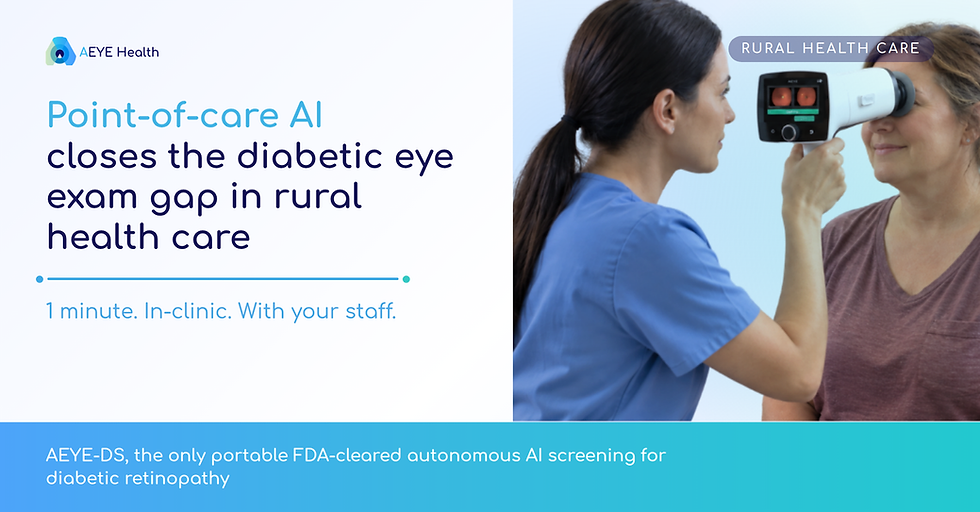
You can deploy an FDA-cleared, 1-minute autonomous diabetic eye screening that effortlessly captures patients at the point of care.
And unlike a lot of grant-funded programs, the revenue doesn't stop when the grant does. Because RHTP funds cover the infrastructure, not the exam itself, every screening performed is billed separately under CPT code 92229, generating revenue on top of the grant, not in place of it.
What the Rural Health Transformation Program actually offers
The Rural Health Transformation Program (RHTP) is a $50 billion federal fund created under the 2025 One Big Beautiful Bill Act, distributed to all 50 states from 2026 through 2030 (CMS, Dec 2025).
States received first-year awards averaging $200 million. Every state's approved plan must dedicate funding to at least three use categories. Two of these line up directly with autonomous diabetic eye screening: chronic disease prevention and management and technology innovation (CMS RHT Program Overview).
This is playing out in real state plans right now:
Texas targets diabetes education and management with measurable outcomes (Texas HHS RHTP Page).
North Carolina funds programs for diabetes and hypertension control (NCDHHS RHTP Page).
Florida finances mobile diagnostic screening units (Florida AHCA Portal).
Wisconsin is investing in digital infrastructure for chronic disease coordination (Wisconsin DHS RHTP Page).
How point-of-care AI screening drives clinical excellence and sustainable revenue
Securing RHTP funds to implement autonomous AI eye screenings allows rural healthcare leaders to address clinical care gaps and operational sustainability simultaneously. Because the RHTP uses a milestone-based framework, state agencies prioritize projects that seamlessly integrate directly into existing primary care workflows.
This is where AEYE-DS changes the equation. As an FDA-cleared, fully autonomous diagnostic technology, AEYE-DS diagnoses referable diabetic retinopathy at the point of care in under 1 minute. It is uniquely suited for point of care, as the only autonomous AI cleared for use with portable handheld fundus cameras, requiring a single image per eye and rarely requiring dilation, with a >99% success rate (imageability).
And everyone benefits, from your clinic and staff to your patients.
By moving the exam into the primary care workflow, your clinic staff ensures virtually all patients are screened, in-visit, closing the care gap on the spot. Your patients receive immediate results during their visit, allowing your organization to instantly satisfy the HEDIS "Eye Exam for Patients with Diabetes" metric and satisfy MIPS Quality Measure 117, protecting your reimbursement while delivering vital, sight-saving care.
To ensure a strong return on investment, AEYE-DS requires no heavy upfront capital. Delivered as a complete software and camera subscription bundle, it integrates directly into your existing EHR, fitting perfectly into state RHTP budgets for digital health tools. Once deployed, the exam is billable under CPT code 92229, turning a grant-funded initiative into a permanent, self-funding revenue engine.
New Revenue, Not Duplicate Funding
Here's the upside: because RHTP funds cover the infrastructure and deployment rather than the clinical exam itself, every screening performed afterward becomes new revenue on top of the grant, not a replacement for it. That's by design. CMS guidance keeps RHTP funds from overlapping with anything already reimbursable by insurance, so the exam remains separately billable under CPT code 92229, historically around $50.
How to get started
RHTP funds are administered directly through your state’s specific RFP, RFA, or RFQ process via a competitive, scored application rather than an automatic entitlement. This means Critical Access Hospitals, RHCs, and FQHCs apply directly to their state managing agency, bypassing CMS entirely, and selection is not guaranteed for every applicant.
If you are outside of TX, NC, FL, or WI, use the National Rural Health Association’s RHTP State Tracker to check active application windows for your specific region. Timelines vary widely, and several states are accepting applications now.
This is a fast-moving, still-forming program, no state has approved AEYE-DS by name yet, but the categories above are exactly where it fits. That openness is good news for organizations ready to make the case early. This overview reflects public program data as of mid-2026, so you to confirm current deadlines with your local state RHTP office before applying.
If we can support your application for any category AEYE-DS fits into, please don’t hesitate to reach out. We’d love to help.
Sources
CMS: "CMS Announces $50 Billion in Awards to Strengthen Rural Health in All 50 States," Dec 2025.
CMS: "Rural Health Transformation (RHT) Program Overview," cms.gov.
National Rural Health Association: RHTP Live 50-State Tracker.
Texas Health and Human Services: Provider Finance Department, RHTP Page.
North Carolina Department of Health and Human Services: RHTP Program Initiatives.
Florida Agency for Health Care Administration: Statewide Medicaid and RHTP Integration Portal.
Wisconsin Department of Health Services: RHTP Infrastructure Projects (and technical data via Wisconsin Collaborative for Healthcare Quality).
Bipartisan Policy Center: "Advancing Technology Innovation through the Rural Health Transformation Program," Mar 2026.
American Academy of Ophthalmology: "Six Out of 10 People with Diabetes Skip a Sight-Saving Exam," 2024.
Burmeister et al.: "Diabetic retinopathy in rural communities: a review of barriers to access of care and potential solutions," PubMed Central (PMC), 2025.