71% of rural clinics don’t have enough eye specialists. Here’s how AI solves this

If you manage a rural clinic or FQHC, you know this scene by heart. Your diabetic patients show up for regular check-ups, A1C checked, and meds refilled. Then they leave, without anyone checking their eyes.
Nobody dropped the ball. The infrastructure simply isn't there.
Nationally, at least 60% of diabetic patients miss their annual retinal exam. In rural America, it’s a full-blown crisis. Geographic isolation and lack of transportation mean rural patients rarely get the eye care they need. So you aren't just managing chronic disease, but also battling the map.
The real numbers behind the gap
According to a comprehensive workforce simulation published in Ophthalmology, ophthalmology faces the second-worst workforce deficit out of 38 medical specialties in the United States.
When you break that data down geographically, the imbalance becomes even more stark. By 2035, while metropolitan areas are projected to maintain relatively stable coverage, non-metropolitan and rural communities will face a critical 71% specialist deficit, leaving them with just 29% of the workforce capacity required to meet patient demand.
The county-level data is even more alarming. A CDC-backed analysis found that 24% of US counties have no eye care specialists at all. For patients in those communities, the referral loop doesn’t just break; It simply never existed.
Faced with this shortage, many primary care providers try manual fundoscopic exams. It sounds like a good workaround, but a study found that PCPs only performed them on 12% of patients, and their sensitivity for actually detecting disease was 0%.
Bringing screening to the patient
Moving retinal screening directly into primary care works, and the evidence is clear:
North Carolina: A telemedicine screening network in rural, underserved areas drove overall screening compliance from 25.6% up to 40.4% after implementation.
Kentucky: An FQHC-based program jumped from 29.9% to 47.7% in year one, holding those gains for four years.
But teleretinal screening introduces severe operational friction. First, poor image quality creates an ungradeable failure rate as high as 30%. When a remote specialist rejects a photo days later, the clinic’s effort is entirely wasted.
Second, the hidden administrative drain is massive: studies show staff spend an average of 60 minutes of back-end coordination time per patient just to track down charts, manage reports, and chase callbacks
Combined with low reimbursement that fails to cover these operational hours, teleretinal models reintroduce the exact administrative bottlenecks and overhead costs you are trying to avoid.
How portable, autonomous AI changes the game
Early point-of-care tools still required remote specialists to read the images. That reintroduced delays and costs that clinics couldn't sustain.
Autonomous AI removes the specialist entirely.
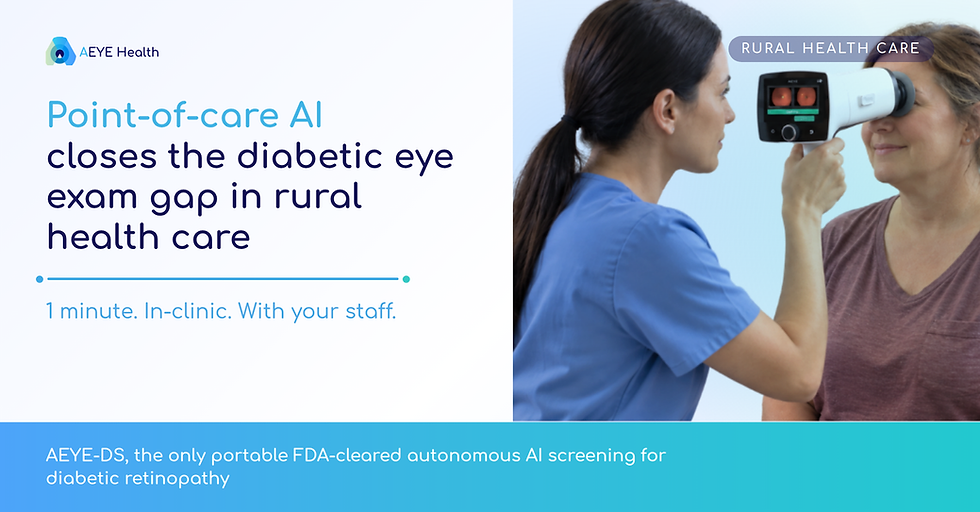
AEYE-DS is the first and only FDA-cleared autonomous AI compatible with a portable handheld camera, and the only system requiring just a single image per eye. Now you can perform a full diagnostic retinal exam anywhere, wherever your clinic is. It takes under a minute from start to finish, requires no dilation, and can be performed by any staff member.
Built for rural workflows
Instant results: If disease is detected, an automated alert goes straight to ophthalmology for prioritized treatment.
EHR integration: Diagnosis is automatically written into the patient’s chart, closing HEDIS care gaps seamlessly. Billing, reporting of CPT 2 codes and referral are all automated as well and require zero staff and/or administrative effort.
Financial sustainability: EHR integration bills automatically under CPT code 92229. Because the AI performs the diagnosis autonomously, there is no fee-splitting, your practice keeps 100% of the reimbursement.
This isn't just a tech upgrade. It solves the accessibility crisis, protecting your patients' vision and your clinic's bottom line.
Closing the gap
Rural patients aren't hard to reach. They are already sitting in your exam rooms. The barrier has always been the infrastructure, and in 1 in 4 counties, the complete absence of eye care providers.
Portable autonomous AI brings the screening to the patient. The care gap is real, and the tool to close it is here.
Want to see how AEYE-DS fits into your workflow? Talk to our product expert
References