Star Ratings 2027: CMS Cut 11 Measures and Kept the Diabetic Eye Exam. Here's Why.

CMS published the “Contract Year 2027 Medicare Advantage Final Rule,” and made one decision every healthcare leader should notice.
Here’s why.CMS eliminated 11 Star Ratings measures. Administrative metrics, process-based box-checking, and redundant data rules are all gone.
But the Diabetes Care - Eye Exam measure stays for a good reason. CMS explicitly cited its critical importance in "preventing serious complications."
And added: improvement efforts will target areas where quality gaps remain, and where patient health can still be meaningfully improved, stripping away box-checking.
The diabetic eye exam sits right at the center of that target. And that's not a footnote, that's a signal.
Outcomes over paperwork: What the 2027 rule actually does
CMS is restructuring Medicare Advantage Star Ratings around a simple principle: focus resources where real performance gaps exist and where patient health can improve.
Removing 11 process measures lets the core metrics shine. The diabetic eye exam sits at the center of this remaining set.It's one of the most persistent quality gaps in Medicare Advantage: screening rates vary widely across the industry, the consequences of missed detection are severe, and yet the gap is entirely preventable with the right care delivery model.
The broken referral loop
The numbers make the urgency clear. Over 40 million Americans live with diabetes, placing them at risk of developing diabetic retinopathy (DR). While DR is the leading cause of preventable blindness in working-age adults, over 95% of such vision loss can be prevented with timely detection.
Yet, at least 60% of patients handed a traditional specialist referral for an eye exam never follow through.
This isn't a patient compliance problem. It’s a care delivery design problem.
Because the traditional referral model forces the care loop into an administrative black box where scheduling friction and system fragmentation derail completion. It has failed at scale for decades.
Referrals go out, patients drop off, HEDIS gaps stay open, and vision is needlessly lost.
And now, under the new CMS framework, this failure becomes much more visible and costly, acting as a direct drag on Star Ratings, bonus payments, and plan competitiveness.
The point-of-care shift that changes everything
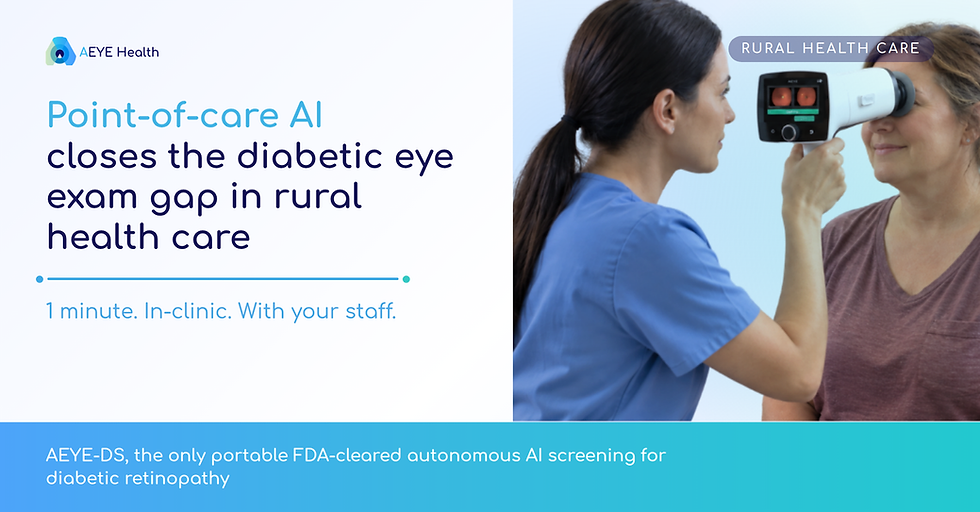
The solution isn't more pressure to a broken pathway. It's moving the screening to where patients already are.That's where AEYE-DS comes in.During a routine visit, clinic staff can complete an AI diabetic eye exam in just one minute. Using the only FDA-cleared portable solution and the only solution that requires just one image per eye, they capture a retinal image and the autonomous AI returns a diagnostic result on the spot. Because it operates at the point of care, there is no need for a separate appointment or an external referral. The screening happens seamlessly, closing the care gap immediately.
Critically, AEYE-DS integrates seamlessly with existing EHR systems, automating billing and reporting at the point of screening. Results are documented, coded, and submitted without additional administrative steps, ensuring every completed exam is captured for HEDIS reporting and Star Ratings compliance.
In a quality framework where the Diabetes Eye Exam directly influences bonus payments and plan differentiation, that automation isn't a convenience, but a competitive advantage. Screening that happens but isn't documented doesn't close the gap. AEYE-DS ensures it does both.
This is what closing the Diabetes Eye Exam gap looks like at scale.
The bottom line
CMS is rewarding clinical outcomes, not administrative compliance. They trimmed the regulatory noise down to the metrics that genuinely differentiate plan performance.
The diabetic eye exam measure is still standing because millions of patients still aren't being screened. Regulators know it.
For health plans and provider organizations heading into 2027, the question isn’t whether diabetic eye screening matters. CMS already answered that. The question is whether your care delivery model is built to actually achieve it.
Ready to close your diabetic eye care gaps at the point of care? Let’s talk.
Resources