How CPT 92229 turns DR screening into a revenue line

For primary care providers, the "referral loop" is often where patient health and practice revenue face their greatest attrition.
Take diabetic retinopathy (DR): the leading cause of blindness in the U.S., despite being treatable in almost 100% of cases when caught early.
Why? Because the system is broken.
Traditional screening workflows are fragmented. Between manual referrals to specialists and multi-step tele-retinal processes, the system is designed to fail at scale.
Research indicates that at least 60% of patients with diabetes miss out on their annual diabetic eye exams, leaving millions of at-risk patients without a vision-saving diagnosis and clinics with administrative fatigue and suboptimal quality scores.
Breaking the referral cycle The solution is a fundamental workflow shift - not better referral tracking, but removing the referral entirely.
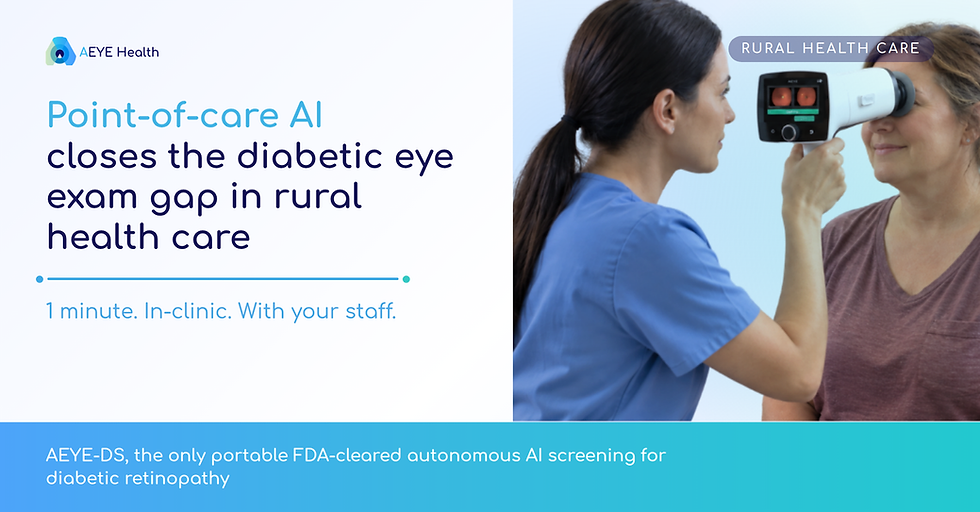
Point-of-care autonomous AI ensures the screening is actually completed during the visit, eliminating the friction of the referral loop. Patients are screened and results are obtained while they're in the room, the care gap closes before they walk out, and CPT 92229 makes it billable.
Defining the new standard: CPT 92229 and autonomous AI
To leverage point-of-care screening, it is essential to understand the specific framework of CPT 92229. Officially defined as "Imaging of retina for detection or monitoring of disease; point-of-care automated analysis and report, capturing and transmission of images".
Unlike traditional teleretina codes (92227 or 92250-TC) that require a human read of the images, CPT 92229 represents a closed-loop diagnostic event. Specifically designed for autonomous AI, CPT 92229 covers the entire screening process, from image capture to immediate, on-the-spot AI diagnosis. The screening is complete during the patient visit: an instant clinical report is generated, the care gap is closed, and the billing event is triggered before the patient leaves the room.
The economics of point-of-care efficiency
The financial case for autonomous AI becomes clear when you compare the systematic inefficiency of traditional models:
Feature | Traditional Referral | Tele-Retinal Screening (92227 / 92250-TC) | Autonomous AI Screening (AEYE-DS) |
Primary Billing Code | N/A (Revenue Loss) | CPT 92227 / 92250-TC | CPT 92229 |
Avg. 2025 National Reimbursement | $0 to PCP | ~$17-18* | ~$45-55 avg. (higher with private payers)** |
Interpretation Method | External Specialist | Remote Physician (Off-site) | Autonomous AI (On-site) |
Length of Exam Cycle | Weeks to Months | Days to Weeks | ~1 Minute |
Patient Completion Rate | <20% (High Attrition) | <70% ~30% returned ungradable | >99% success rate |
Maximizing HEDIS and MIPS 117
Beyond direct reimbursement, retinal screening performance directly impacts HEDIS scores and MIPS 117 (Diabetic: Eye exam), both increasingly tied to value-based payment. Every lost referral is a direct hit to those metrics, since they measure the percentage of diabetic patients who actually receive an eye exam. Research indicates that switching to autonomous AI can lead to significant improvement in screening adherence (Huang et al., 2024; Yun et al., 2024). By moving the exam to the point of care, reporting becomes automated and compliance becomes a byproduct of the patient visit.
From code to clinic: AEYE-DS in practice CPT 92229 reimbursement starts with getting the exam done. AEYE-DS makes that simple: as the only FDA-cleared autonomous AI solution with a portable camera and the only AI that requires just one image per eye, it delivers on-the-spot screening in 1 minute and results in under 5 seconds - no dilation and no separate appointment. It fits existing patient flow, improves clinical throughput, and turns DR screening into a sustainable revenue line.
The bottom line
The most expensive exam is the one the patient never gets. While CPT 92229 provides the financial framework for reimbursement, autonomous AI is the clinical vehicle that ensures the exam actually takes place. By moving to a point-of-care screening model, your clinic ensures that patients receive vision-saving care, and the practice is fully compensated - all before the patient leaves the room.
Resources:
Non-adherence to eye care in people with diabetes ❘ Murchison ❘ 2017FDA approval Diabetic Retinopathy Detection Device AEYE-DS K221183