Healthy Vision Month: Optimizing Population Health Outcomes

May is Healthy Vision Month, but for population health leaders, it is more than a patient-facing awareness campaign - it is a valuable opportunity to refine system-wide clinical pathways. While awareness is the first step, it’s often not the primary bottleneck. The real challenge lies in the structural friction between identifying a patient with diabetes and successfully closing their diabetic eye screening gap. Healthy Vision Month serves as a natural checkpoint to evaluate how changed workflows can help close the diabetic eye care gap and prevent avoidable blindness at scale.
The Opportunity: Optimizing the "Last Mile" of Care
Even with strong clinical guidelines, reaching the “last mile” of diabetic eye screening can be a complex logistical task. While referral pathways and teleretinal programs were designed to close this gap, they often introduce new layers of friction that limit their effectiveness. Diabetic retinopathy remains one of the leading causes of preventable blindness in the U.S., not because it is difficult to detect, but because screening execution at scale is inconsistent.
Traditional models reveal persistent gaps, with more than 60% of patients missing their annual screening. This is further complicated by the teleretinal “ungradable” problem, where up to 30% of images cannot be interpreted, and patients are returned to the referral loop, eroding efficiency gains and impacting quality metrics. Fragmented paths leave primary care providers without real-time visibility into screening status, limiting coordinated chronic disease management. The result is a persistent blind spot in population health: patients are technically “in care”, but not consistently screened at the frequency needed to prevent disease progression.
The New Standard: Point of Care Screening
Most health systems still rely on external ophthalmology referrals, annual reminders, manual outreach campaigns, and claims-based reporting to track screening compliance. While well-intentioned, these approaches depend heavily on patient follow-through outside the primary care visit, introducing delays, friction, and loss to follow-up. As a result, screening remains reactive rather than embedded within routine care delivery.
Due to persisting diabetic eye care gaps, there is growing alignment in clinical guidance and health system strategy toward moving diabetic eye screening closer to the point of care. This is supported by the American Diabetes Association 2026 Standards of Care, which highlight the benefit of moving screenings to the patient point of care. This shift allows providers to manage diabetic population outcomes more holistically by screening patients on-the-spot, during routine visits, where they are already actively engaged.
The Role of AI: Enabling Scalable Point-of-Care Screening
AI is becoming a core infrastructure layer in diabetic eye screening - an enabler of scalable population health. It allows immediate screening in primary care, real-time detection of referable disease, reduced reliance on specialists, and seamless integration into routine visits. This shifts screening from a referral bottleneck to a point-of-care workflow, enabling systematic screening of entire diabetic populations and improving screening rates, care gap closure, and value-based care performance.
AEYE-DS: Closing the Diabetic Eye Screening Gap in Primary Care
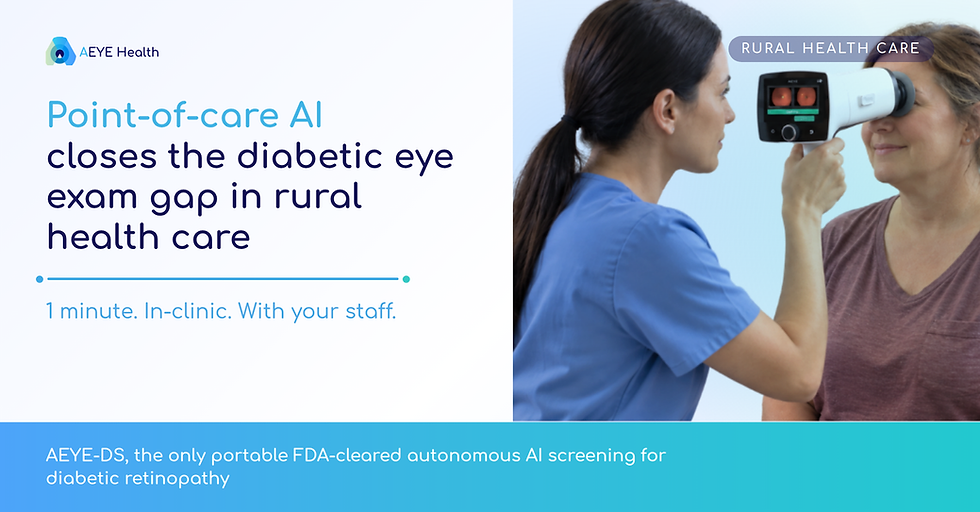
AEYE-DS brings screening into primary care. As an autonomous AI solution, it facilitates screening during routine patient visits without requiring a separate specialist appointment, and is the only FDA-cleared solution compatible with a portable camera, enabling true point-of-care deployment in settings with limited imaging infrastructure.
With a workflow requiring just one image per eye, completed in 1-minute, with instant results at the point of care, AEYE-DS makes screening a standard part of routine care. This supports screening adherence, enables early detection, and delivers a scalable, reliable solution.
Healthy Vision Month is the perfect time to ensure our infrastructure matches our commitment to patient care. Systems that integrate AI diabetic eye screenings are leading the way in closing care gaps and protecting the gift of sight for their communities.
Resources