Why “Come Back Later” Doesn’t Belong in Preventive Eye Screening in 2026

Every time a primary care physician hands a diabetic patient a specialist referral for a diabetic eye exam, a ticking clock begins. The patient nods, walks out the door, and the "come back later" loop starts.
Too often, "later" becomes "never."
In the past, relying on external referrals for routine preventive eye screening was a logistical necessity. But in 2026, forcing patients into a fragmented referral pipeline for annual screenings isn’t just inefficient, it’s an outdated clinical approach.
The clinical community has recognized this shift, officially endorsing the transition to point-of-care screening. The 2026 ADA Standards of Care explicitly support the use of autonomous AI as an appropriate screening strategy for diabetic retinopathy.
Bringing autonomous AI diabetic eye exams into point-of-care is no longer a futuristic luxury; it is the modern standard for proactive medicine.
The Leaky Pipeline of Traditional Referrals
The traditional "refer out and wait" model is fundamentally broken. The data on traditional referral networks exposes a massive structural leak, more than 60% of referrals for diabetic retinopathy screening never complete. Too many obstacles are in the way: a severe shortage of specialists, extensive scheduling backlogs,patient-facing friction like mandatory dilation, and even transportation limitations.
But major vision threats are notoriously silent. By the time a patient notices a blurry patch, irreversible structural damage to the retina has already occurred.
When specialist screenings require a separate referral and scheduling pipeline for an asymptomatic condition, it introduces a major operational bottleneck, too often resulting in missed opportunities for early, preventative care.
Enter point of care autonomous AI Screening
The integration of FDA-cleared, fully autonomous AI diagnostic tools has completely rewritten the screening playbook by moving the diagnostic capability directly to point-of-care.
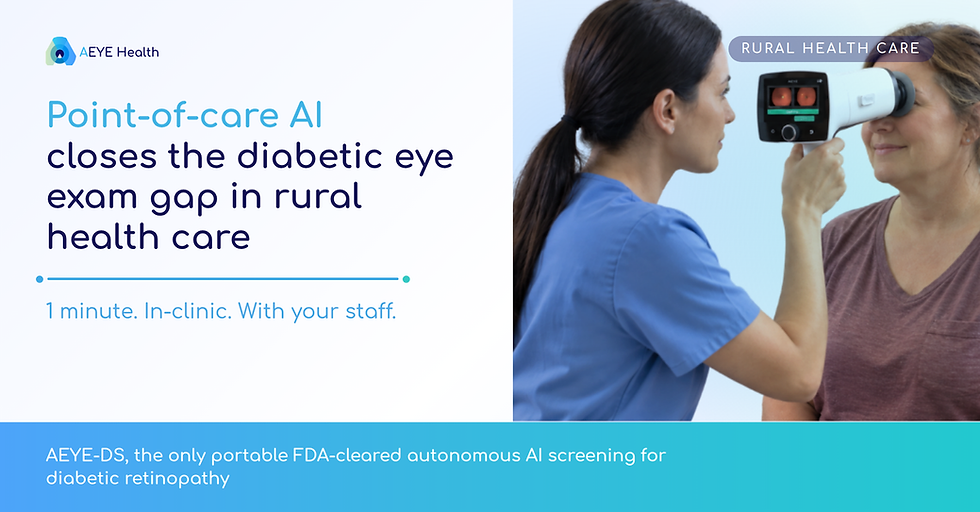
At AEYE Health, we’ve eliminated the friction that used to make in-clinic screening a hassle. AEYE-DS, the only FDA-cleared portable autonomous AI solution and the fastest growing solution in the U.S., delivers a 1-minute diabetic eye exam, meaning that staff can easily screen patients using a single image per eye, delivering instant results right at the point of care.
Point-of-care workflow delivers:
Instant, Autonomous Results: No waiting for a remote reading center. FDA cleared autonomous AI, delivering diagnostic outputs in 1-minute.
Seamless workflow integration: EHR flags patients due for the exam, the results are directly filed to the patient’s record, CPT 92229 billing and care gap closure reporting automated, ensuring no at-risk patient slips through the cracks.
Point of care screening that actually happens: Screen during the routine visit with just one image per eye and an instant diagnosis. No dilation, no separate appointments. The most practical place to screen is the room they are already in.
Move the Screening, Save the Sight
Transitioning to point-of-care AI screening doesn't just protect patients, but it also optimizes the entire medical ecosystem. It allows clinics to become diagnostic hubs.
By automating routine screening at the point-of-care, we ensure every patient receives their annual screenings, compliance metrics are met, and positive cases receive timely, vision-saving intervention.
In 2026, the technology is seamless, the reimbursement pathways using CPT 92229 are established- closing the diabetic eye care gap, and the clinical stakes are too high to ignore. It's time to retire the leaky referral pipeline. Don't tell them to come back later- screen them now with AEYE-DS.
Resources