National Rural Health Day 2026: One Year Into the Rural Health Transformation Program
This National Rural Health Day, November 19, rural healthcare has something it has rarely had before: a multi-year federal investment already moving through every state. Ten days earlier, CMS announced the second year of Rural Health Transformation Program (RHTP) funding, bringing total awards to $20 billion out of the $50 billion five-year initiative across all 50 states.
The stakes are high. CMS notes that rural Americans live about three years less, on average, than their urban peers. Rural hospitals and clinics are also bracing for Medicaid changes that KFF projects will cut federal Medicaid spending in rural areas by about $137 billion over the next decade, with nearly two-thirds of those reductions hitting after 2030, right when federal grant funding ends.
One year in, RHTP has moved from applications to action.
RHTP at a glance, one year in
RHTP sends $10 billion a year to states from 2026 through 2030. Half is split evenly, so every state gets at least $100 million a year. The other half reflects rural needs and, starting this year, how well each state is carrying out its plan.
States decide how to spend their RHTP funding, and their plans share clear priorities. CMS built the program around five core strategic goals, including Make Rural America Healthy Again and Tech Innovation, and state budgets reflect that dual focus. Chronic disease appears in every state plan, alongside major investment in AI tools (40 states) and mobile health.
The direction is consistent: use technology innovation to move specialist-level care out of distant settings and into primary care and mobile care. And because part of each future award now depends on results, and states must prepare clinics for the post-2030 Medicaid cliff, states favor turnkey projects that launch quickly, show measurable outcomes, and can sustain themselves after the grant ends.
Why chronic disease and tech innovation are the lever states keep pulling
Chronic disease is the only focus area in every state plan, and it’s easy to see why: it’s where rural gaps are widest and where results can be measured. CMS lists high chronic disease rates alongside workforce shortages and limited specialty capacity as core rural challenges. At the same time, states cannot hire their way out of rural specialist shortages, which is why CMS’s Tech Innovation pillar backs point-of-care diagnostics and autonomous AI that let existing clinic staff deliver specialist-level care on the spot. Relying on outside specialist referrals is where patients fall through the cracks.
Diabetic eye disease shows why pairing chronic disease management with point-of-care technology works. Over 60% of patients with diabetes miss their annual eye exam, and the gap is wider in rural communities with no eye care provider nearby. (We covered what that looks like inside a clinic in Solving the Diabetic Eye Exam Burden in Rural Health Care).
Where AEYE-DS fits the priorities states are funding
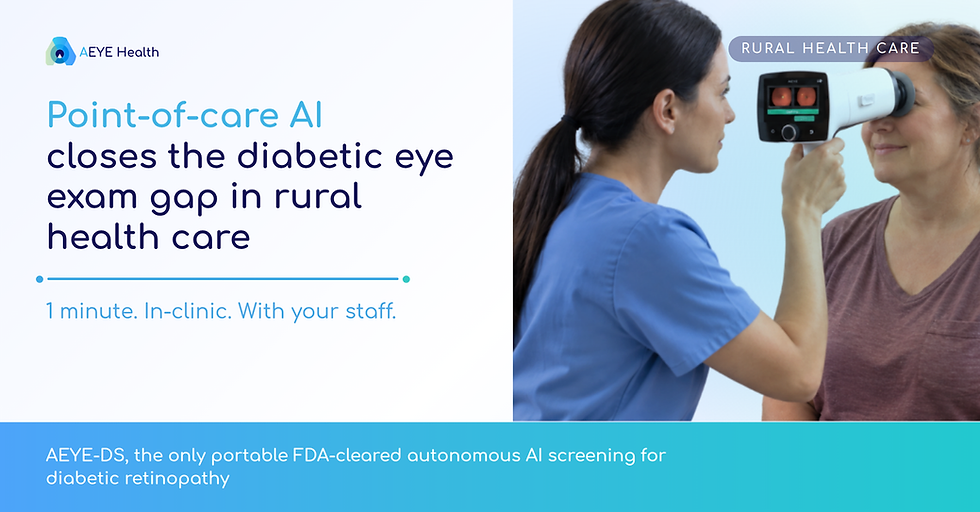
AEYE-DS is built for exactly the shift state plans describe: No need for physician interpretation, results delivered on the spot where rural patients already get care. It is an FDA-cleared, fully autonomous AI that diagnoses more-than-mild diabetic retinopathy in under 1 minute. Existing clinic staff can be trained in under an hour to capture one image per eye, without dilation. The results are produced instantly, automatically written into the EHR, and discussed with the patient during the visit.
Today, AEYE-DS is the fastest growing solution in the US for diabetic eye exams.It features the only FDA-approved AI that requires just one image per eye, and is also the only autonomous AI for diabetic retinopathy cleared for use with portable handheld cameras (while also being cleared on a robotic tabletop camera), so the exam can go wherever the program goes. The 2026 ADA Standards of Care name AEYE-DS directly , and Recommendation 12.6 recognized FDA-cleared AI as an effective way to close diabetic eye exam gaps at the point of care.
The results are measurable, which is exactly what states now need to show. A recent meta-analysis found that point-of-care AI screening nearly triples diabetic eye referral completion in U.S. clinics. At Bethesda Health Clinic, a nonprofit serving uninsured and underinsured working adults in East Texas, staff began screening patients after basic training, with no doctor needed to perform or read the exam. In a three-week pilot, the clinic screened 126 patients and found 19 (15%) with referable diabetic retinopathy, each with a result on the spot and a clear next step.
Here is how it lines up with the program types states chose most often:
State priority | States with related initiatives | How AEYE-DS fits |
Chronic disease | 50 | Closes the annual diabetic eye exam, a core diabetes quality measure (HEDIS EED, MIPS 117), in the same visit |
Mobile healthcare | 30 | Handheld camera clearance means screening can run in different locations including mobile clinics and community sites |
Clinical Decision Support & Predictive Analytics | 22 | Autonomous diagnosis at the point of care: FDA-cleared autonomous AI delivers the result during the visit, with no specialist read. |
Sustainable access (CMS checkpoint) | All states | Each exam is billable under CPT 92229 in fee-for-service clinics, so the service keeps paying for itself after grant-funded deployment, while helping FQHCs and RHCs capture encounter-based visits in-house and protect quality incentives after grants end. |
State counts from CMS, BP1 State Focus Areas.
Celebrating the power of rural
National Rural Health Day honors the clinicians, staff, and population health leaders who keep care in the communities that need it most. This year, they have new resources and a real chance to reshape rural healthcare for the long term.
At AEYE Health, we believe rural patients deserve the same diabetic care as anyone else, without a day-long drive to get it. That is why we built AEYE-DS to run in any primary care clinic, rural health clinic, FQHC, or mobile unit, within the workflow and EHR the staff is already running.
Visit our RHTP Help Center to see how it fits your state's plan.
Sources
CMS, Trump Administration Announces $10 Billion in Second Year of Rural Health Transformation Awards to All 50 States, Nov 9, 2026
CMS, Rural Health Transformation Program: Year 2 Awards fact sheet, Nov 9, 2026
CMS, Budget Period 1 Planned State Initiatives (State Focus Areas)
CMS, More Than $19 Million to Expand Telehealth, Specialty Care, and the Healthcare Workforce Across West Virginia, Oct 30, 2026
States Newsroom, Feds award $10B to states in second year of rural health grants, Nov 10, 2026